Case study ·
Professional.ee — A Practical Guide to Freelancing in Estonia
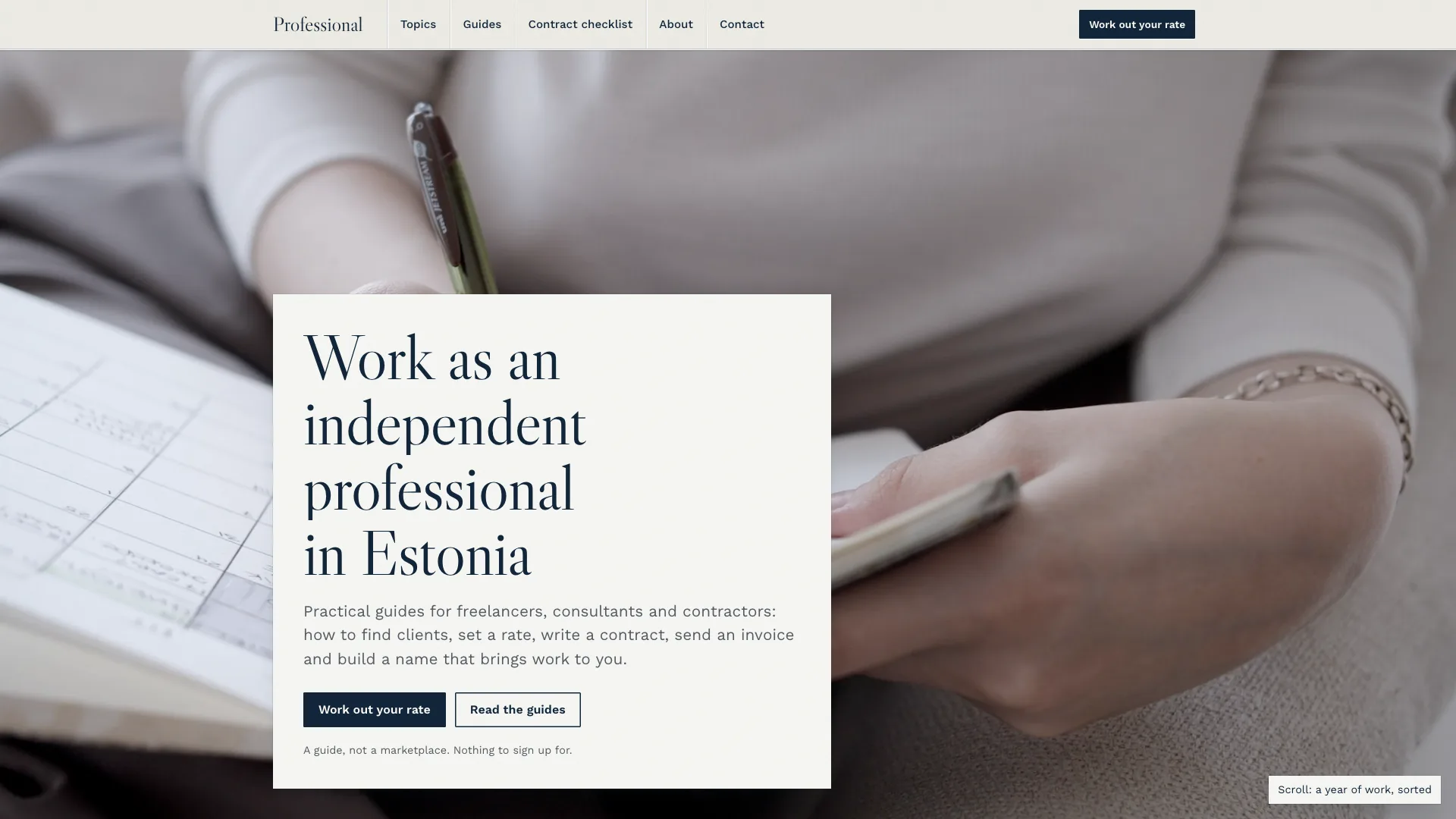
Professional.ee is an English-language guide to working independently in Estonia. It covers the business side of selling your own skills: finding clients, setting a rate, choosing between a sole proprietorship, a private limited company and an entrepreneur account, writing a contract, invoicing and getting paid. Its homepage starts from a simple fact, that a year has 365 days and you can invoice far fewer, and sorts the year until only the billable days are left. We designed and built the site end to end, and still run it. It went live on 14 November 2026.
The opportunity
Skilled people go freelance because they are good at the work, and then discover the rest of the job: pricing, contracts, invoices and where the next client comes from. In Estonia there is a further layer, because there are several ways to work independently, each with its own paperwork, tax treatment and liability.
The readers are locals, expats and remote workers who invoice Estonian or foreign clients, and many look for the answer in English. The gap with most rate advice is that it quotes market rates that nobody can verify. A rate that is copied from someone else's does not cover your own holidays, admin and unpaid pitching, and that is exactly where freelancers lose money.
The brief was a guide that teaches the calculation instead of quoting a number, explains the Estonian options without jargon, and is honest that it is general information, not tax or legal advice.
What we built
A year of work, sorted
The homepage scroll story is a year, sorted the way a planner sorts it. It starts with 365 days left to bill. Then five things come out, each on its own step: 104 days of weekends, 35 days of public holidays and leave, 6 days of sickness, 30 days of admin and 30 days of unpaid pitching. What is left is 160 billable days, which have to earn the whole year. The page does the sum in front of you: 48,000 euros of revenue the business needs, divided by 160 billable days, is 300 euros a day. The figures are labelled as an example, not a market rate and not tax advice.
Seven topics, grouped by the job
The seven topics are finding clients, building a reputation, setting rates, invoicing and getting paid, contracts, legal forms for freelancers, and taxes and social cover. They are grouped under three headings that match the work: winning work, getting paid, and legal and admin. Each is a short, plain answer with the points to remember.
Four guides that answer first
The four guides compare FIE, OÜ and entrepreneur account, explain what a freelance contract should include, work out how much a freelancer should charge, and give a step-by-step plan for finding clients. Each opens with the direct answer, shows a reading time of four or five minutes and carries its last-updated date. The rate guide follows five steps: decide the income you need, add business costs, count the hours you can bill, calculate the floor, then compare with the market and with the value of the work.
A rate calculator and a contract checklist
The rate calculator takes five figures of your own and returns a day rate and an hourly rate with every line of the sum shown, labelled as a floor rather than a market price. Next to it on the homepage is a weekly grid: click or drag across the hours in a working week that a client would pay for, and it shows what share of the week is billable. The contract checklist lists 13 clauses, from parties and scope to liability, termination and governing law, and explains what goes wrong when each is missing. Both tools run in the browser. The site states that they contain no tax rates, fees or legal thresholds, that nothing a visitor enters is sent to the site, and that the checklist ticks stay in that browser.
Built for search and AI assistants
The homepage has a six-question FAQ with FAQPage structured data, plus Organization and WebSite markup. There is an RSS feed, an llms.txt listing every topic and guide, and a sitemap. A footer line repeats that the content is general information, not tax or legal advice. Stock photographs are credited on a footage and photo credits page, and the typefaces, Libre Caslon Display and Work Sans, are open-licence fonts.
The result
Professional.ee went live on 14 November 2026 with seven topics, four guides, two tools, an RSS feed and an llms.txt. It is too new for results, and we do not claim any. What it gives a freelancer is a way to find their own number: a rate they can defend, a contract that covers the usual gaps, and an honest line between guidance and advice.