Case study ·
Payments.ee — Getting Paid in Estonia, Without Quoting a Fee
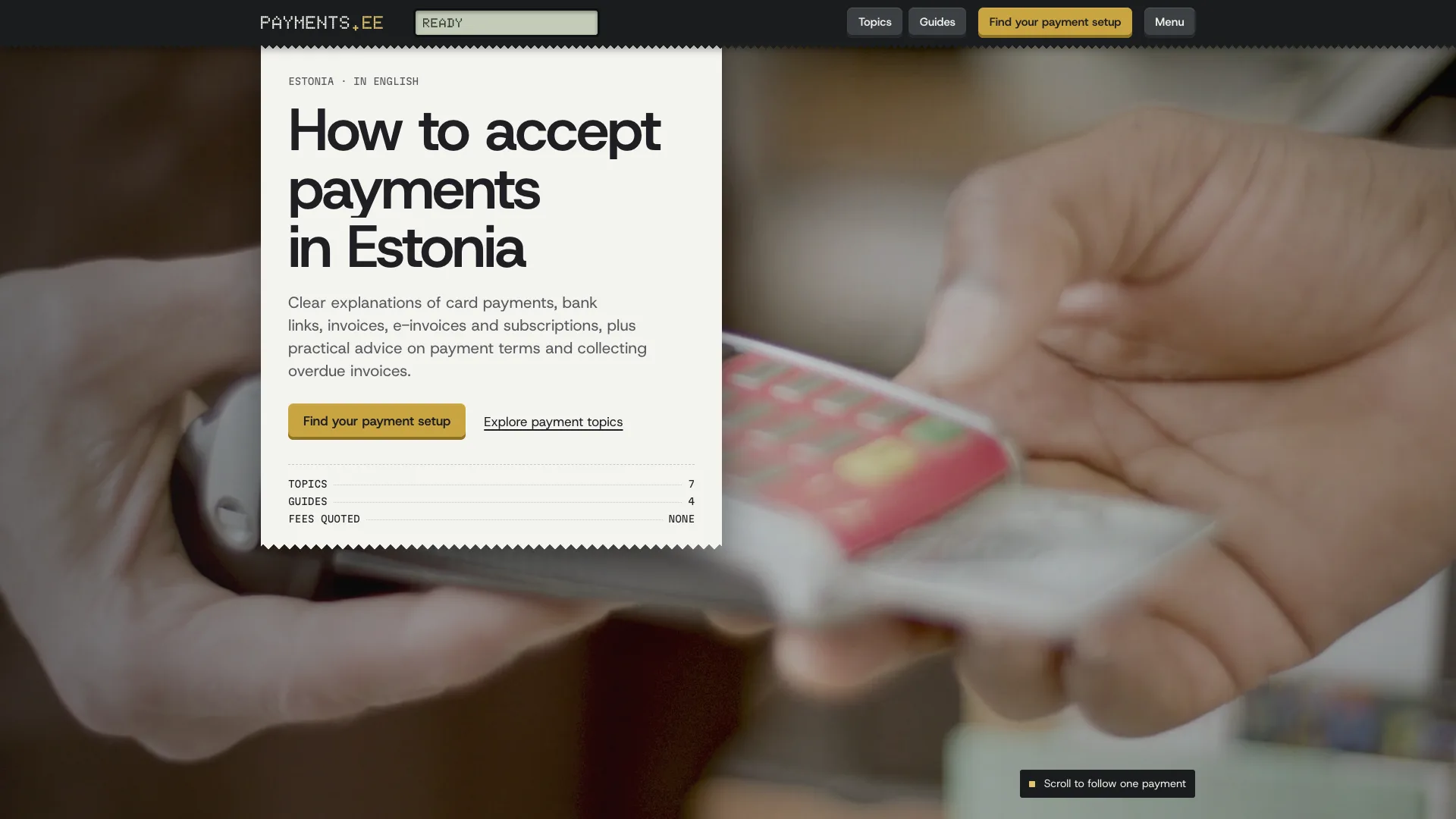
Payments.ee is an English-language guide to getting paid in Estonia. It explains the methods businesses use, which are card payments, bank links and pay-by-bank, invoices, e-invoices and recurring payments. It also covers the commercial side: setting payment terms and collecting overdue invoices. It is written for small businesses, online sellers, freelancers and foreign companies entering the Estonian market. We designed and built the site end to end, and we still run it.
The opportunity
Almost every business needs to get paid, and very few people can say what happens between the customer's tap and the money in the account. The explanations that exist are mostly written by providers, who have something to sell, or are buried in contracts. Prices make it worse: they depend on volume and change often, so a guide that quotes them goes stale quickly and can mislead.
Estonia adds its own twist. Shoppers know paying directly from their online bank, and e-invoices move between accounting systems without retyping. A foreign company arriving here has to learn both, in English, from a source that is not selling a particular provider. The brief was a guide that stays on the seller's side and is straightforward about what it leaves out.
What we built
One payment, followed after the tap
The homepage is a scroll story about a single card payment, with a receipt-paper card in the hero reading "Present card" and "Approved". The reader follows the payment through six stops: Terminal, Processor, Card network, Customer's bank, Settlement, Your account. Each stop states what happens, how long it takes and what it costs, from "about a second at the counter" to the settlement period set in your contract. The story ends with a line the whole site stands behind: at the end the fees arrive as one line, so ask for them broken down. A small counter in the hero keeps the promise visible: topics 7, guides 4, fees quoted none.
The same sale, paid three ways
Further down, a wheel moves through the days after a sale, and a receipt prints what has happened to a card payment, a bank link and an invoice by then. The invoice branch runs through a due date, a friendly reminder, a call and a formal demand. The days are marked as an example, since the real payout day comes from the provider's contract and the due date from the seller's own terms.
Seven topics and four guides
The topics are card payments, bank links and pay-by-bank, choosing a payment provider, invoices, e-invoices, subscriptions and recurring payments, and payment terms and late payments. The four guides compare card payments, bank links and invoices, explain the cost of accepting payments, lay out how to chase late payments step by step, and explain what an e-invoice is and who has to use one. Each opens with the direct answer.
Two tools that stay in the browser
The payment-setup chooser asks four questions about where you sell, the typical amount, one-off or recurring billing and who pays. It returns a recommended mix of methods, with the reasoning and the questions to put to a provider. The late-payment timeline takes an invoice date and a payment term and returns dated reminder steps with wording you can adapt. Both run in the browser and send nothing, and by design they encode no fee, interest rate or legal threshold.
Honest about what it does not know
The about page is direct: no fees are quoted and no providers are ranked, because both change faster than a guide can. Every page carries a note that the content is general information, not legal or financial advice. For search and AI assistants, the site has FAQPage structured data, an RSS feed and an llms.txt with a full-text companion. Footage comes from Pexels and is credited on its own page.
The result
Payments.ee went live on 13 November 2026, built in a week. It has seven topics, four guides and two tools, and a rule that the site follows throughout: explain the fee types, leave the numbers to the providers' current price lists.