Case study ·
Product.ee — Product Management Guides for Small Teams
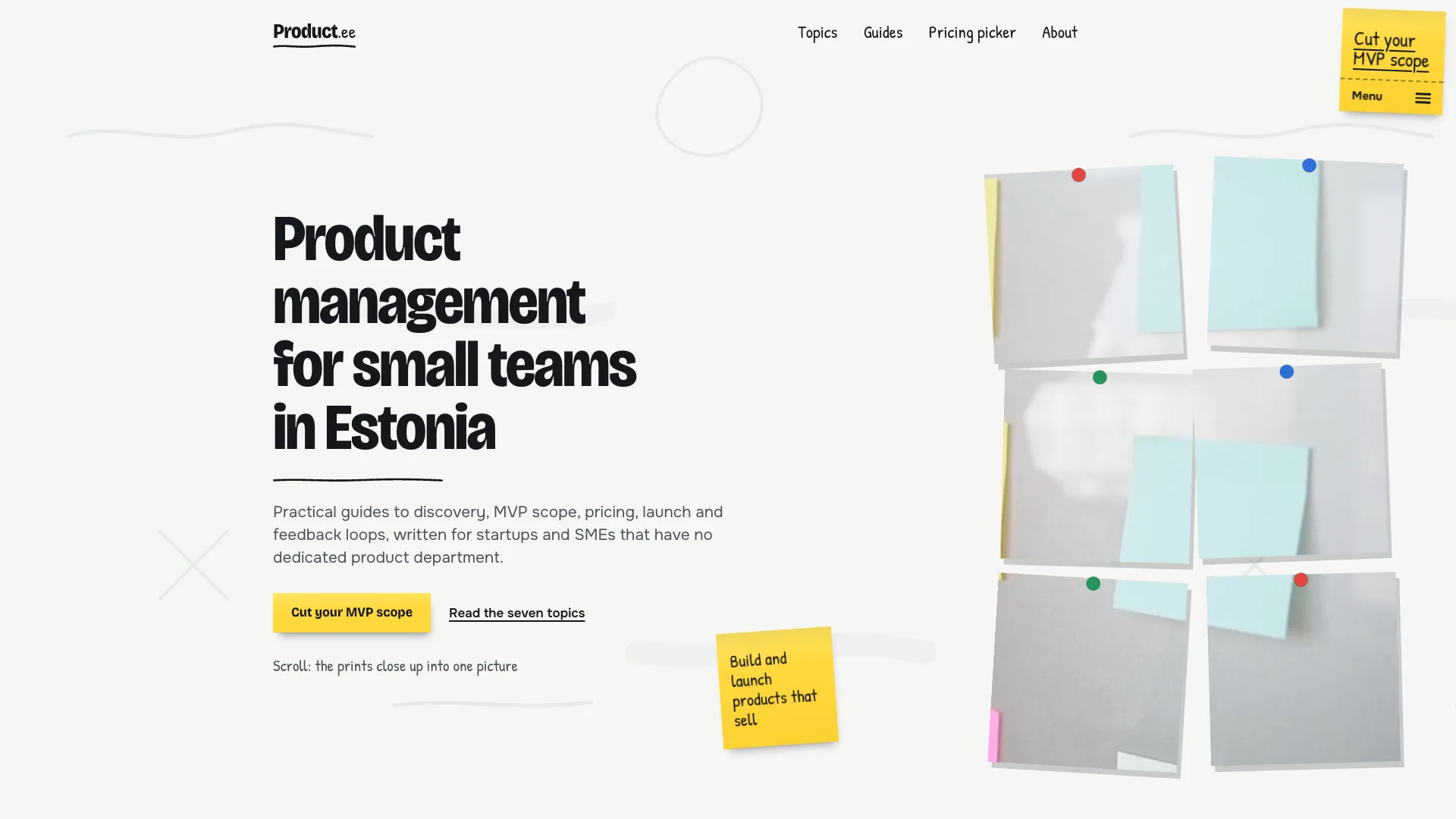
Product.ee is an English-language guide to product management for startups and small and mid-sized companies. It follows the path from idea to a product people pay for: discovering a real problem, interviewing customers, scoping a minimum viable product, setting a price, planning a launch and learning from feedback. Its homepage is a wall of sticky notes, where forty ideas go up and five ship. We designed and built the site end to end, and still run it. It went live on 15 November 2026.
The opportunity
Most product advice assumes researchers, analysts and a design team. The readers of Product.ee are founders, first product managers and small teams in Estonia and elsewhere who do product work alongside other jobs, with a few people and limited time.
What they need is short and practical: who to talk to, what to ask, what to build first, what to measure. The guides favour simple methods that a team of two to twenty can actually use, and they stay light on theory and buzzwords. A second need is the numbers. Questions such as what an MVP costs or how to price a first release deserve an answer that explains the drivers instead of printing a figure nobody can check.
The brief was a guide that reads like a working session, with an honest scope and tools that let a team do the exercise on its own list.
What we built
Forty ideas on a wall
The homepage scroll story is a wall of sticky notes in five steps: collect, cluster, vote, cut and line up. Collect puts every request, hunch and competitor feature on a note, with nothing judged yet. Cluster moves notes that answer the same customer problem next to each other. Vote hands out a few dots, far fewer than there are notes, because a limit turns a wish list into a decision. Cut lets most of it fall: whatever the first user does not need comes off the wall, and waits for evidence. Line up leaves one row with one date under it, and that row is the MVP. The headline says it plainly: forty ideas go on the wall, five ship. Steps two to four link to the product discovery, roadmap and MVP scoping topics.
Seven topics in the order the work happens
The seven topics are product discovery, customer interviews, MVP scoping, roadmap and prioritisation, pricing, launch planning and feedback loops. They are arranged in four columns, Discover, Build, Launch and Learn, and a six-step path on the homepage links each stage of the work to its topic.
Four guides that answer first
The four guides cover what product discovery is, how much an MVP costs for an Estonian startup, how pricing models compare, and how to launch a B2B product in stages. Each opens with a short direct answer and carries a last-updated date. The discovery guide, for example, frames the work around four risks: whether customers want it, whether they can use it, whether you can build it and whether it works for the business.
An MVP scope cutter and a pricing model picker
The MVP scope cutter lets a team type the features it is arguing about, mark each as must, should or could and as small, medium or large, and see what ships and what waits, with a plain-words reason for each. The pricing model picker asks three questions about who buys, how value grows and how the product is sold, and narrows seven common pricing models to the ones that fit. It suggests a structure, not a number. A sample list of eight ideas on the homepage lets a visitor put five dots on the notes first. The site says both tools run entirely in the browser and that nothing a visitor types is sent to it; the cutter keeps its list in the browser's local storage so it is still there on return.
Built for search and AI assistants
The homepage carries a six-question FAQ with FAQPage structured data, plus Organization and WebSite markup. There is an RSS feed, an llms.txt that lists every topic and guide, and a sitemap. Stock photographs are credited on a credits page. The About page states the scope without ambiguity: it publishes guides and two browser tools, sells nothing and stores nothing a visitor types.
The result
Product.ee went live on 15 November 2026 with seven topics, four guides, two tools, an RSS feed and an llms.txt. It is too new for results, and we do not claim any. For a small team it offers a workable order of operations, a way to cut a feature list in an afternoon and a pricing shortlist, all without a sign-up.