Case study ·
Harbor.ee — A Ferry Guide That Boards You Before You Leave Home
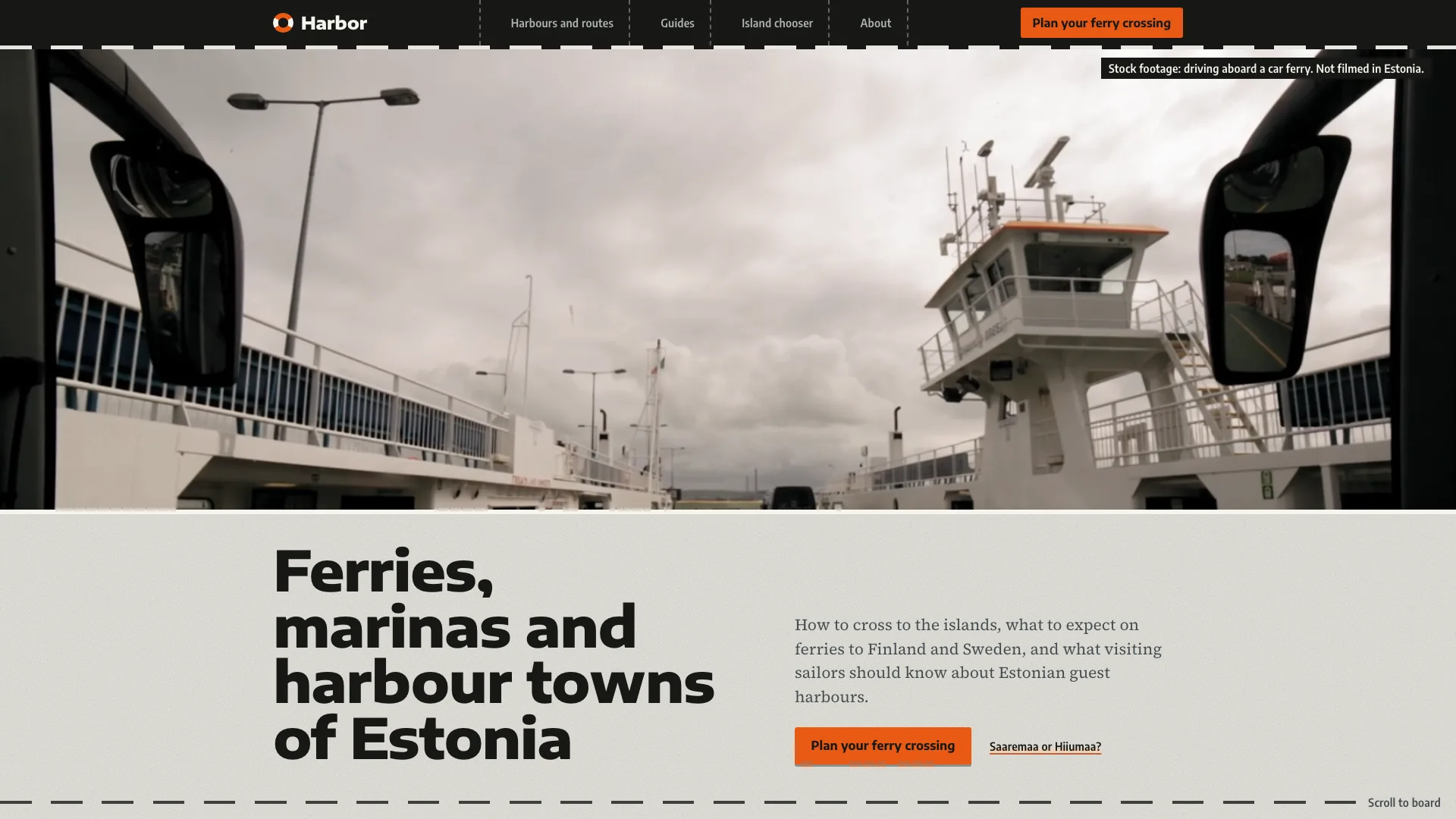
Harbor.ee is an English-language guide to the harbours, marinas and ferry connections of Estonia. It explains how the car ferries to Saaremaa and Hiiumaa work, how the smaller islands are reached, what to expect on sailings to Finland and Sweden, and how guest harbours serve visiting yachts. It is written for visitors planning a crossing and for sailors arriving by their own boat. We designed and built the site end to end, and we still run it.
The opportunity
A ferry crossing looks simple until you are standing in the wrong lane. Which harbour serves which island, whether to book the vehicle place, what the general queue is and what happens at peak times are things first-time visitors learn on the quay. The pages that do explain them tend to sit next to timetables and fares, and those change every season.
Sailors have a similar gap: what a guest harbour is, how mooring works and which papers to carry when arriving in Estonia by boat. The brief was a guide for both kinds of traveller that explains how the system works, is clear that it sells nothing, and leaves current figures to the operators.
What we built
One crossing, quay to quay
The homepage is a scroll story about a single crossing with a car, five steps long: wait in your lane, roll aboard when it is released, handbrake on and go up, open water, drive off steadily. Each step gets a short, practical caption, such as about half an hour to Muhu and Saaremaa and a little over an hour to Hiiumaa. The ferry in the scene is a procedural model of a generic vessel, built in code, and the site says it shows no real ship or operator. A step-by-step guide sits behind the story for readers who want the detail.
Before you leave home
Four things settle a crossing with a car: choose the route and its harbour, check the timetable for your date, book the vehicle place online and know the general queue. Each links to the page that explains it. Further down, a small interactive lets the reader drag a life ring from a quiet weekday to Midsummer and watch the pre-booked lane and the general queue fill. The site labels it as an illustration of the pattern, not a forecast.
Seven topics and four guides
The seven topics are the ferry to Saaremaa, the ferry to Hiiumaa, small island ferries, ferries to Finland and Sweden, Tallinn's harbours, marinas for visiting sailors and harbour towns. The four guides cover guest harbours for visiting sailors, what the ferry to Saaremaa or Hiiumaa costs, how to take a car on the island ferry, and how to choose between Saaremaa and Hiiumaa. Each opens with the direct answer and carries its reading time.
Two tools that stay in the browser
The island chooser asks what you want from the trip and how long you have, then returns one island, the reasons and what you give up by not choosing the other. The crossing planner asks five questions about the crossing, how you travel, when and how fixed your plans are, and returns the steps in order on one printed page. The planner stores its answers in the reader's own browser and sends nothing anywhere.
Independent, and honest about it
The about page says Harbor.ee is not a ferry operator, a harbour or a booking service, and that it sells no tickets. It publishes no timetables, fares or berth fees and points to the operator or the harbour for them. The homepage captions its stock footage as "Not filmed in Estonia", and a credits page lists every clip and photograph and its source. For search and AI assistants, the site has FAQPage structured data, an RSS feed and an llms.txt.
The result
Harbor.ee went live in November 2026, built in a week. It has seven topics, four guides and two tools, and a rule it follows throughout: explain how the crossing works, leave the current numbers to the operators.