Case study ·
Airlines.ee — Airline Types Explained, Drawn as One Aircraft
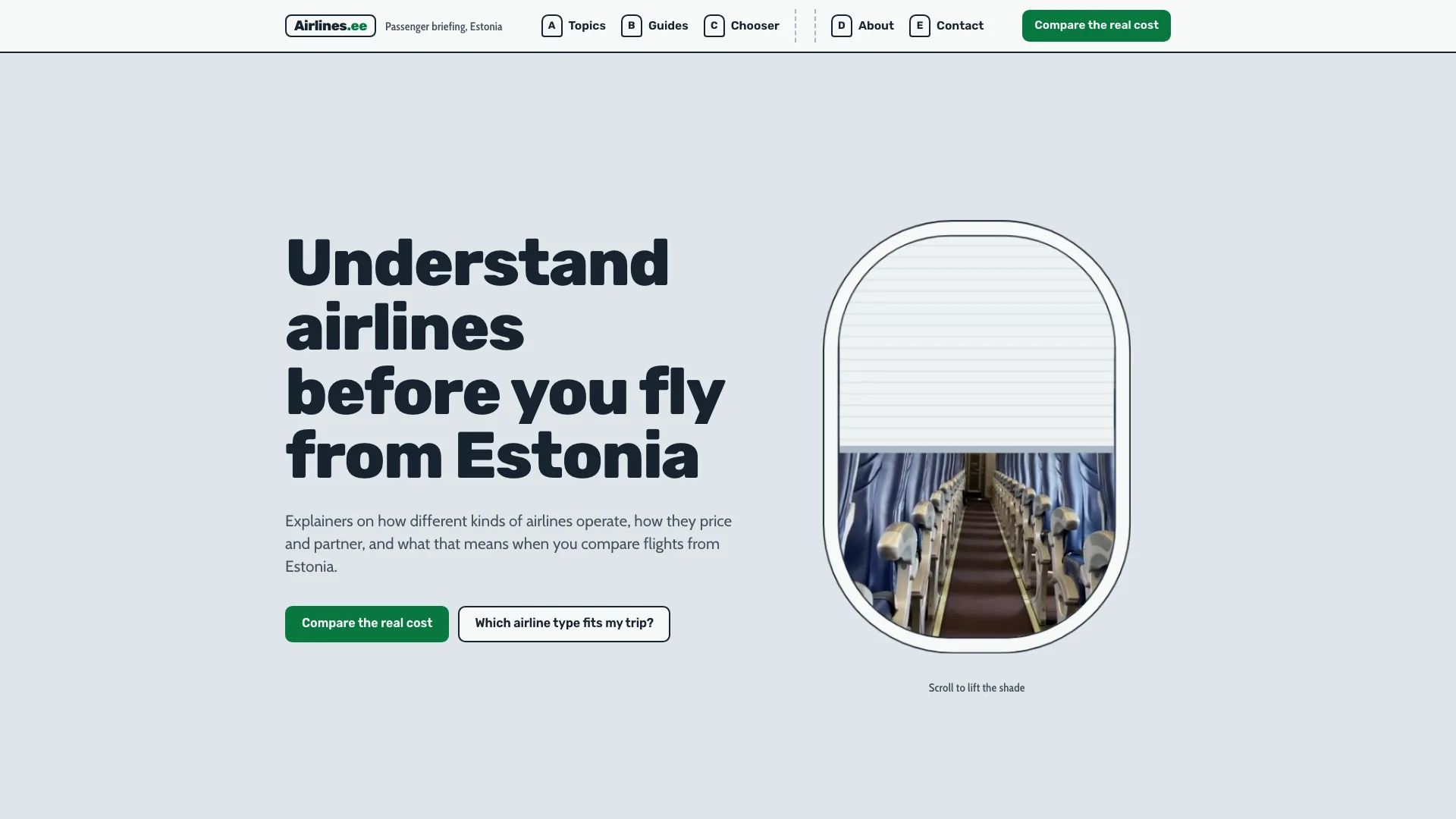
Airlines.ee is an English-language explainer on how different kinds of airlines operate, price and partner, written for travellers comparing flights from Estonia. It covers low-cost, full-service and charter carriers, and the systems behind a ticket: alliances, codeshares, fare classes and loyalty programmes. It sells no tickets and ranks no airline. We designed and built the site end to end, and we still run it.
The opportunity
Most people compare flights by the fare shown, and the fare says little about what the ticket includes. A low-cost airline sells a bare seat and charges separately for almost everything else, a full-service airline bundles more, and a charter flight is usually sold inside a package holiday. From Estonia, where longer journeys often mean a connection and a choice between several carriers, the vocabulary adds to the confusion: codeshare, fare basis, interline, status tier.
The brief was a guide from the buyer's side that stays general, so it does not go stale. It names no airline as best and quotes no airline's fees, because those change too often to print.
What we built
One aircraft, opened along its length
The homepage is a scroll story about a cabin. As the reader scrolls, the fuselage opens from the front row to the back, in five stops: the whole aircraft, the front rows, the main cabin on standard and flex fares, the main cabin on a light fare, and the last rows. Each stop lists what is usually included, what varies by airline and what is usually an extra. The drawing is generic, with no airline's seat map and no airline's rules. Its first lesson is that the cabin class is where you sit and the fare is the set of rules that came with the ticket.
Price the trip, not the ticket
A five-step method sits below the story: start with the fare shown, add the bags you will really take, decide whether seats matter, check which airport it is, and price the change you might make. A slider then moves along a fare family, Light, Standard, Flex and Business, and shows what each one carries with it. It is labelled as a typical pattern, since names and contents differ between airlines.
Seven topics and four guides
The topics sit in three rows: airline types (low-cost airlines, full-service airlines, charter flights), partnerships (airline alliances, codeshares), and tickets and rewards (fare classes, loyalty programmes). The four guides cover codeshare flights, how to choose an airline from Estonia, how to earn and use airline miles, and what a flight really costs on a low-cost versus a full-service airline. Each states its conclusion at the top and then shows the working.
Two tools that stay in the browser
The real-cost sheet takes two fares you are looking at, then what each would charge for bags, seats, food, getting to the airports and changing the booking. It adds them up and names the lines that made the difference. The airline type chooser asks five questions about the trip, luggage, how fixed the plans are, connections and miles, and answers with a type of airline, never a named one, with its reasons. Both run in the browser and send nothing, and no airline's price is built in.
Evergreen, and open about it
The site says it sells no tickets, ranks no airline and quotes no airline's fees, and each guide is dated with its last revision. The few blocks that point to sister projects carry a "From our network" label. Footage and photographs are stock material, credited on their own page. For search and AI assistants, it has FAQPage structured data, an RSS feed and an llms.txt.
The result
Airlines.ee went live in November 2026, built in a week. It has seven topics, four guides and two tools, and it explains how a fare is built by showing one aircraft opened from front to back.