Case study ·
Kullakelux — A Trilingual Shopify Storefront That Sells Trust Before It Sells Jewellery
Kullakelux sells fine jewellery that somebody else already owned. Gold, diamonds, coloured stones — bought in, inspected by an in-house goldsmith, restored, and put back on sale from a counter at Kalda tee 15 in Tartu. Their tagline is the whole business in four words: Ilule uus elu. Beauty given a new life. Our job was to take that counter online, in three languages, without losing the one thing the counter has and a website does not — a person standing behind the piece, holding it up to the light.
The opportunity
Selling pre-owned luxury online is not a catalogue problem. It is a trust problem, and it runs in the opposite direction from every other e-commerce category.
When you buy a new ring, the brand carries the risk. The box, the certificate and the shop floor have already answered every question you might have had. When you buy a pre-owned ring for €675 from a website, every one of those questions comes back at once, and they are not polite ones. Is the gold what the listing says it is? Has the stone been swapped? What is the actual condition — "excellent" according to whom? Who fixes it if the setting gives out in four months? And the quiet one underneath all of them: why is this ring for sale at all?
A second-hand marketplace answers none of that and is honest about it — you are buying from a stranger and you know it. Kullakelux is the opposite proposition. There is a workshop, a goldsmith and a shop with opening hours behind every listing. The entire commercial advantage sits in that difference, and none of it survives the trip to a web page unless the site is built to carry it.
The market added a second constraint. Tartu buys in three languages. Estonian is the working language, Russian is a first language for a large share of the country, and English is how anyone shipping elsewhere in Europe arrives. Those are not one storefront with a language switcher bolted on. Search behaviour, phrasing and price expectations differ across all three, and a jewellery buyer types kihlasõrmus, обручальное кольцо and engagement ring into three separate futures.
What we built
Certified Pre-Owned, argued on every single listing
The trust problem does not get solved on an About page that nobody reads. It gets solved at the moment of hesitation, which is halfway down a product page with a €479 ring on the screen.
So the guarantee lives there. Every listing carries a Certified Pre-Owned block that states exactly what was done to the piece and by whom: professionally appraised and authenticated by in-house jewellers, metals hallmark-verified, gemstones inspected for quality, then cleaned and restored to wearable condition. Above the price sit three badges — INSPECTED, AUTHENTICATED, WARRANTY — and beneath it two fields that most pre-owned sellers leave to the imagination: Condition: Pre-Owned and Warranty: 24 months.
Twenty-four months is the number that does the work. Anyone can write "excellent condition." A two-year warranty is a claim that costs the seller money if it is wrong, and buyers read it that way. It is the single most persuasive element on the page, and it is not a design decision — it is a business decision the site was built to make legible.
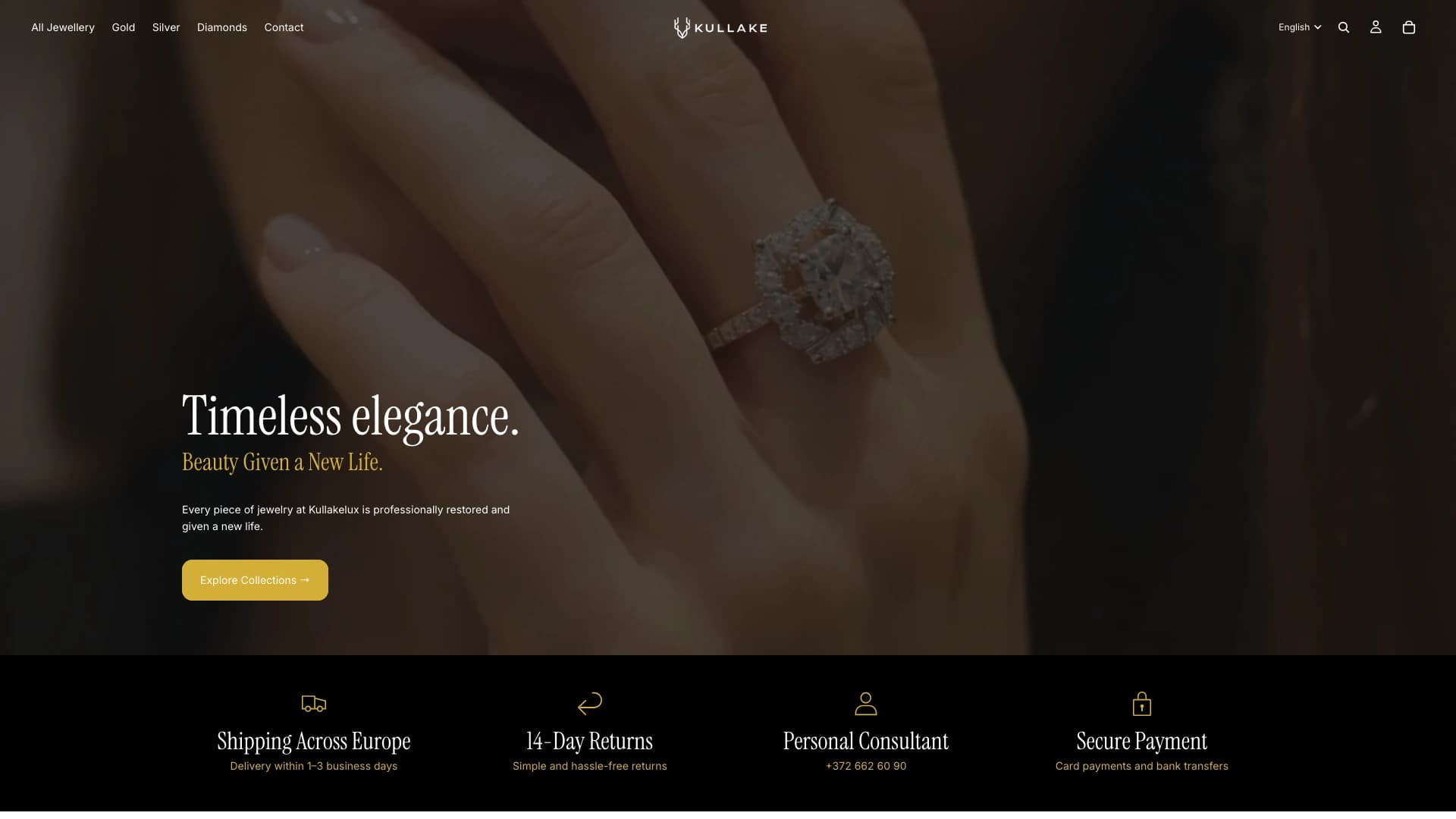
Four more guarantees run as a fixed bar directly beneath the hero and again on every product page: shipping across Europe in one to three business days, fourteen-day returns, secure card and bank-transfer payment, and a personal consultant with a phone number rather than a contact form. The phone number is deliberate. For a category where the objection is "I want to talk to a human before I spend this," a ticketing system is the wrong answer.
A catalogue where every listing is a single object
Pre-owned inventory breaks the assumptions ordinary commerce merchandising is built on. There is no restock. There is no size run. There is no second unit.
The Kullakelux catalogue is sixty-six rings and sixty-six variants — one listing, one ring, one fixed size, four photographs, every item published as a single physical object. Options describe the piece rather than offering a choice: gemstone type, cut style, and the one size that ring happens to be. Eight product types carry the taxonomy in the shop's own language — üksikkivisõrmused, mitmikiviga sõrmused, kokteilisõrmused, pitsatsõrmused, virnastatavad sõrmused, kihlasõrmused — because these are jeweller's categories, not marketing ones, and the customer standing at the Tartu counter uses exactly those words. Prices run from €115 to €1,749, with the median piece at €352: a real accessible-luxury spread rather than a showcase of three expensive things.
Every description is written gemologically, not adjectivally — marquise-cut emeralds set diagonally across a polished yellow gold band, small round accent stones between them. That specificity is doing double duty. It reassures a buyer who knows what they are looking at, and it gives search engines and AI assistants concrete, quotable text about an object that exists nowhere else on the internet.
Trilingual, with Estonian holding the root
Estonian is authoritative and serves from the bare domain with no prefix; Russian sits at /ru and English at /en. Every page publishes the complete four-value hreflang set — et, ru, en and an x-default pointing at the Estonian original — so search engines are told plainly which version is canonical for whom instead of guessing from a header.
That last detail matters more than it sounds. Get it wrong on a multilingual store and Google quietly picks one language, indexes it, and treats the other two as duplicates of a page they are not. Two-thirds of the catalogue goes dark and nothing appears to be broken.
Black, gold, and a serif with a jeweller's hand
The storefront is near-black — #131313 under a full-bleed hero — with a single accent: #D4AF37, which is not a designer's approximation of gold but the hex the word has meant for decades. Headings are set in Instrument Serif, a high-contrast display face whose thick-to-thin transitions read like something engraved; interface text and body copy are Inter, which stays quiet and lets the metal be the loud thing. Two typefaces, two colours, one photograph. Everything else on the page is jewellery.
The hero is video rather than a still — hands turning a gold chain, a halo diamond catching light as a finger moves. Jewellery is one of the few categories where motion is not decoration: a stone that does not throw light in the picture looks like glass. A static hero on a diamond store is a missed argument.
Choosing Shopify, and choosing not to build
We have written the opposite case study — taking a client off a hosted platform because it was capping their design and their page speed. So it is worth saying why the answer here went the other way.
The difference is where the hard part lives. Eesti E-pood needed to win search results and hold a bespoke motion system; the platform was in the way. Kullakelux needed inventory, tax, multi-currency, PCI-compliant checkout, returns and payment methods Estonian buyers already trust — all solved problems, none of them a differentiator, every one of them expensive to get wrong. Building that from scratch would have converted the client's budget into a worse version of something Shopify already ships. Horizon, Shopify's current theme architecture, is built on web components and section-level hydration, so a customised copy of it renders fast without any of that being our problem to maintain.
The 2026 argument is stronger still. Shopify storefronts now expose an agent-readable commerce surface out of the box — a published agents.md, a UCP discovery document at /.well-known/ucp, an MCP endpoint for catalogue and cart, and a separate agentic-discovery sitemap alongside the normal one. As buyers increasingly ask an assistant to find them a rose-gold cocktail ring under €700, Kullakelux is already answerable in the format the assistant wants, with checkout still gated behind explicit human approval. That is a substantial piece of infrastructure the client did not pay us to build, and recommending the platform that includes it is worth more than the invoice for building it badly.
Good engineering judgement is mostly knowing which problems are yours. This one's weren't.
The workshop, given its own page
The restoration service is the reason Kullakelux can make the guarantees it makes, so it is a destination rather than a line in the footer. The page states the work plainly — cleaning and polishing, rhodium plating for white gold, resizing, chain and clasp repairs, stone tightening and replacement, scratch removal, restoration of vintage pieces — then walks through the process step by step: bring the piece in, a specialist inspects it, you get a quotation, nothing starts until you approve it, you collect it.
It is also the store's second business. A customer who brings in a grandmother's ring for a free assessment is standing at the counter, and the fastest route from a website to a jeweller's counter is a page that tells someone their heirloom is fixable.
The result
Kullakelux went live in August 2026 with sixty-six one-of-one rings across three languages, every listing carrying an appraisal, a hallmark check, a condition statement and a two-year warranty on the same screen as the price. The site does not ask anyone to take pre-owned luxury on faith. It shows the work — the goldsmith, the inspection, the warranty, the address in Tartu and the phone number of a person who will pick up — and lets a ring that has already had one life go and find its next one.