Case study ·
Deal.ee — AI-Indexed Business Intelligence and Marketplace for Estonia
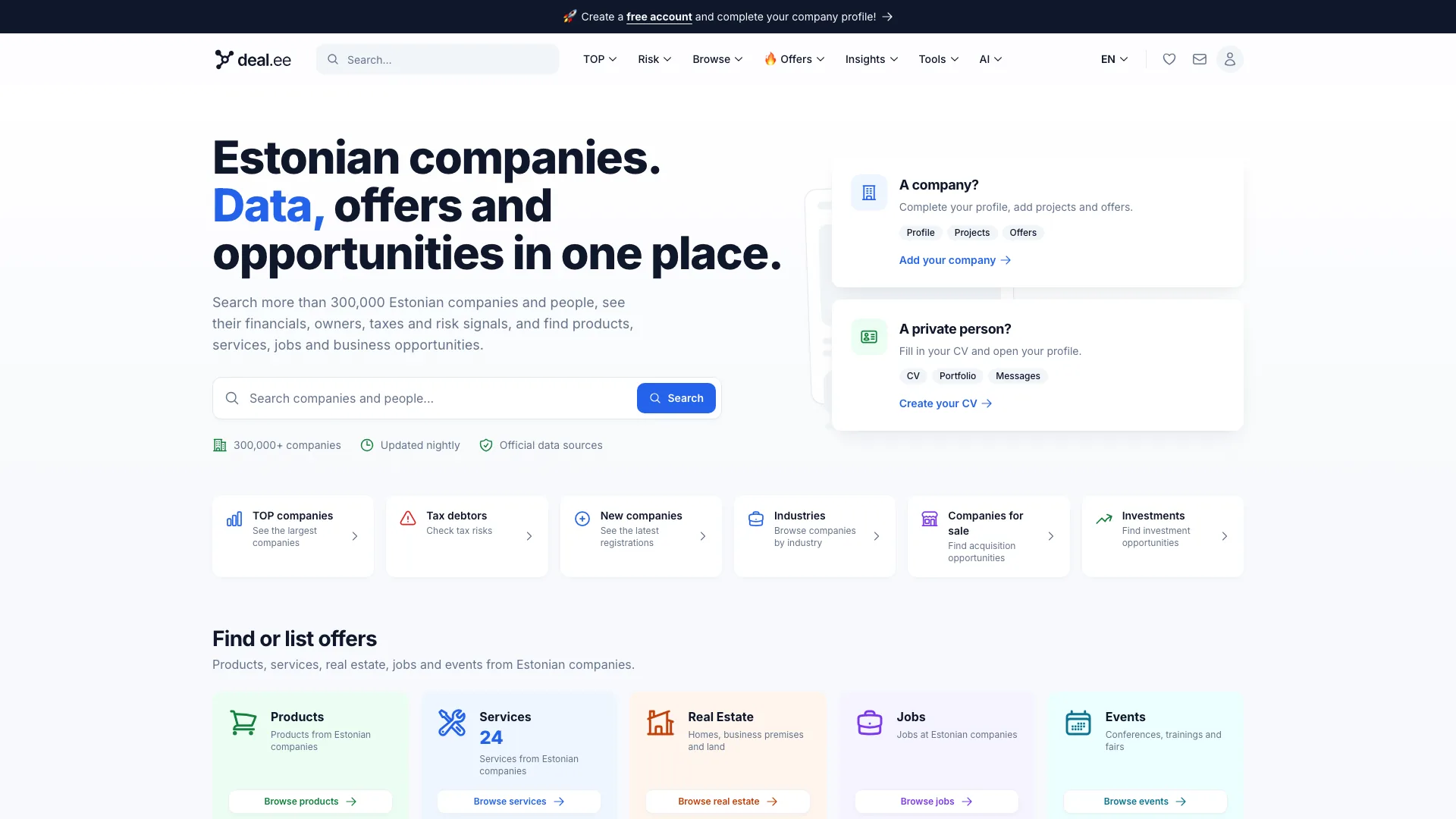
Deal.ee is two products in one. First, an AI-indexed intelligence layer over Estonia's public business data — every company, owner and annual report, normalized from nineteen government datasets, refreshed daily, and engineered to be cited as a primary source by ChatGPT, Claude, Perplexity and Gemini. Second, a marketplace on top of that data: companies verify ownership with their national eID and claim their profile today, and a full offers layer — products, services, real estate, companies for sale, investments and jobs — is rolling out on top. It's free to the public, served in Estonian, Russian and English, and built end-to-end in Go on PostgreSQL.
The opportunity
Public registry data is rich but hostile to use. It arrives in different formats across multiple agencies, on overlapping schedules, with no shared identifier discipline across sources. Turning it into something fast, current and trustworthy is hard engineering. But the bigger opportunity sits on top of the data: the companies inside that registry have no fast, AI-visible home of their own — nowhere to tell their story, raise capital, or be found by the AI assistants people now use to research a business. Deal.ee does both — it makes the data usable and citable, then hands each company the keys to its own page.
What we built
AI-first discoverability
Deal.ee is engineered to be a primary source for ChatGPT, Claude, Perplexity and Gemini. Machine-readable manifests — an llms.txt, a full-detail variant, and a .well-known AI-plugin descriptor — tell crawlers exactly what's here and how to cite it. Every entity page carries JSON-LD (Organization, Person, Dataset, BreadcrumbList), explicit citation metadata, a speakable summary, and an AI-quotable natural-language paragraph — all server-rendered, so a crawler retrieving a company sees structured, attributable content without running a line of JavaScript. The sitemap spans roughly 2.2 million URLs across three languages, every entry hreflang-aliased and stamped with the daily refresh date.
The intelligence layer
Behind every page is a daily-normalized view of Estonia's public record: around 368,000 companies and 365,000 people, drawn from nineteen government datasets — registrations, registry cards, shareholders and beneficial owners, commercial pledges, annual reports with full financial indicators, and tax data. On top of the raw records sit views the source registries don't offer: risk listings (tax debtors, in-liquidation, bankrupt), TOP rankings by sector and by salary, and analytical browsers for revenue by country, economic activity, newly registered companies and a by-location map. One searchable, cross-linked layer where the government publishes a dozen disconnected files.
The company marketplace
This is where Deal.ee stops being a directory and becomes a platform. A company's representative claims its profile by verifying through Estonia's national eID — Smart-ID, Mobile-ID or ID-card — and, once approved, the profile carries a public "Verified" badge and unlocks for editing. From there the company controls how it shows up: a full marketing page — tagline, overview, logo, websites, contact people, social links, locations and a call-to-action. The same data that makes a company findable now makes it ownable — a provably-verified front door, and the foundation for the offers marketplace coming next.
Multilingual at scale
Three languages — Estonian, Russian and English, the languages of Estonian business — served from Go's html/template with locale-aware routing and zero hydration cost. HTMX drives partial swaps for search, filters and navigation, so the site feels instant without a client-side framework; Alpine.js handles the small local reactivity where it's needed. The result is essentially as fast as static HTML, interactive where it counts, and fully translated for crawlers and users alike.
The engine room
The data keeps itself current: a daily ETL pipeline auto-discovers each dataset's latest URL straight from the source agency, so a quarterly reshuffle upstream doesn't need a human. Background work — emails, notifications — runs on a Postgres-backed River job queue with retries, so the web process stays responsive under load. A database-backed feature-flag system toggles capabilities live in production without a restart, a hardened identity layer handles accounts and sign-in, and company logos live in object storage. The whole platform is self-hosted on infrastructure the team owns, fronted by a CDN, with OpenTelemetry tracing into Grafana for visibility.
What's next
The roadmap turns a verified profile into a place to do business:
- An offers marketplace — verified companies list across six categories: products, services, real estate, companies for sale, investments (equity raises and loans) and jobs — every offer attached to a real, verified company and indexed for AI search like everything else on Deal.ee.
- Paid tiers — subscriptions that unlock a power-user toolkit — change alerts, AI-powered search, data-table CSV exports and more — alongside premium profile and listing features for verified owners.
- Watchlists — follow companies and get notified the moment something changes.
- Lead routing and analytics — turn AI-driven and on-site discovery into qualified inbound.
- News and an AI assistant — a business-news layer and an AI companion for exploring the data conversationally.
The result
A platform that's two things at once: the fastest, most AI-citable view of Estonia's business record, and the place where those same companies come to be seen and do business. Around 368,000 companies and 365,000 people, nineteen datasets, three languages, roughly 2.2 million URLs — refreshed every day, and, crucially, showing up when someone asks an AI assistant about an Estonian company.