CarFog — A Trilingual, AI-Optimized Storefront for Dry-Fog Car Disinfection
A cinematic trilingual storefront for CarFog's dry-fog interior disinfection — a custom GSAP fog motion system over a full SEO + GEO layer (schema, llms.txt, hreflang) built to get found and drive equipment sales.
- Client
- CarFog OÜ
- Industry
- Automotive care
- Timeline
- 3 weeks
- Year
- 2026
- Stack
- Next.jsGSAPLenisTailwind CSSTypeScript
- Live site
- www.carfog.eu
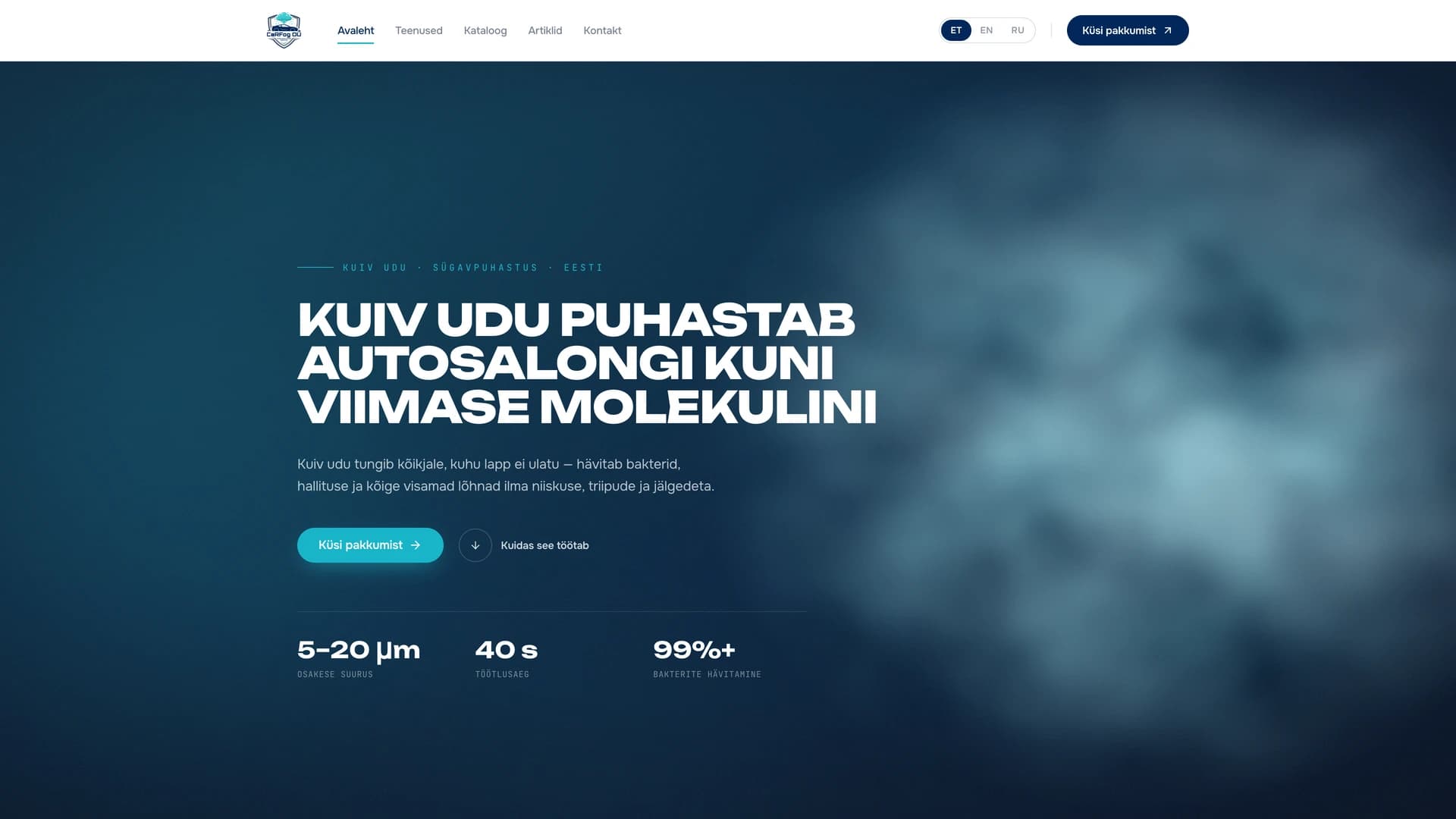
We partnered with CarFog OÜ to bring dry-fog interior disinfection to Estonia's car-care market — and to solve the harder problem sitting underneath it: how do you sell a technology most buyers have never heard of? The answer is a cinematic, trilingual storefront in Estonian, Russian and English that does two jobs at once — it teaches people what dry fog is, and it makes sure that lesson gets found by Google and cited by the AI assistants people now ask for recommendations. A bespoke GSAP motion system carries the story on the surface; a full SEO and GEO engine drives it underneath.
The opportunity
Dry fog is genuinely better than a cloth and a spray can, and that's exactly why it's hard to sell. A glycol-based liquid is atomized into 5–20 micron particles that behave like a gas, filling the whole cabin and reaching the vents, the A/C evaporator and deep into the fabrics — places manual cleaning never touches. It binds and destroys odor molecules at the source instead of masking them with fragrance, kills bacteria, fungi and mold, and evaporates without leaving moisture, streaks or residue. The problem isn't the technology. It's that almost nobody typing "how do I get the smoke smell out of my car" has ever heard the words "dry fog."
CarFog needed a site that closes that gap — one that educates and converts at the same time, for four very different buyers: car washes and detailing studios adding a service, used-car dealers turning around trade-ins, and entrepreneurs weighing a turnkey self-service machine as passive income. And it needed to win that attention in three languages, at the exact moment discovery is shifting from a page of blue links to a single AI-generated answer.
What we built
A visual identity that is the product
The site doesn't describe dry fog. It is dry fog. The hero is a real volumetric fog cloud built entirely in the browser — fractal SVG noise tinted teal and white, blurred and masked into soft, billowing plumes that drift on two stacked layers at different frequencies. As you scroll, GSAP scrubs the fog's opacity down and lifts it upward at two independent parallax rates, so the whole scene breathes. Numbers count up from zero to the ones that matter — a 5–20 µm particle size, a 40-second treatment, 99%+ of bacteria destroyed. Headlines split into individual words that rise and fade into place. Lenis smooth-scrolling is wired straight into the GSAP ticker so nothing stutters, and the call-to-action buttons pull gently toward the cursor. None of it is a template — it's a custom motion library written for this one brand, where the visual language and the product are the same thing.
Engineered to be found — SEO and GEO
This is the part that actually drives sales. Every page ships a full, server-rendered schema.org graph — Organization, Product, Service, Article, FAQPage, BreadcrumbList and ItemList — so search engines and AI crawlers read the site as structured facts, not just paragraphs. A hand-authored llms.txt hands those crawlers a clean, quotable summary of what dry fog is and everything CarFog sells, so an assistant answering a question can lift an accurate description instead of guessing. Canonical URLs and hreflang tags — including an x-default — keep all three languages correctly cross-linked rather than competing with one another, and the sitemap.xml and robots rules are generated dynamically from the content itself.
On top of that sits a real content library: 18 in-depth articles — six topics, each written natively in Estonian, Russian and English and cross-linked by translation key — covering what dry fog is, thermal versus cold foggers, choosing the right liquid, removing specific car smells, interior disinfection, and running a self-service dry-fog business. The whole thing is built for one outcome: when someone asks ChatGPT, Perplexity or Google how to get a smell out of their car, CarFog is the answer that gets cited.
Trilingual by architecture
CarFog sells into a market that lives in three languages, so translation couldn't be an afterthought. We built it on next-intl with fully localized routes — the services page is /teenused in Estonian, /uslugi in Russian and /services in English, not a query string bolted onto one canonical URL. Estonian is the authoritative default and serves from the bare domain with no prefix; the fonts ship Cyrillic and Latin-extended subsets so Russian text and Estonian diacritics render crisply instead of falling back to a system face. It reads as three native sites — because to a search engine and to a customer, that's exactly what it is.
The dry-fog story, told simply
Educating a skeptical buyer is a content problem, and we designed the page to answer questions in the order people ask them. A plain-language explainer covers what dry fog actually is; a six-step walkthrough shows how a treatment runs — pay, pick a scent, prep the cabin, about 40 seconds of fog, 10–15 minutes sealed, then a short airing; and an odor-by-odor breakdown names the exact smells it beats: tobacco, pets, damp, mold, the A/C funk and spoiled food. A FAQ answers the safety and how-long questions everyone has — and doubles as FAQPage structured data for search. For the entrepreneur, a dedicated section makes the turnkey-business case: an autonomous machine running 24/7 at a gas station or car wash, low cost per treatment, high margin, payback in months. And a custom in-browser catalogue viewer — a keyboard-navigable flipbook with zoom — lets a serious buyer page through the full 19-page device catalogue without leaving the site or downloading a file.
Cinematic without the jank
A fog scene that melts a phone is a fog scene nobody sees. A lot of dry-fog buying happens on a phone in a car-wash forecourt, so before the first pixel paints, a tiny inline script tags iOS devices and swaps the expensive fractal-noise filters and heavy blurs for cheap gradients, pauses anything animating off-screen, and steps aside entirely for anyone who's asked their system to reduce motion. The pages render statically and load instantly. The result is a site that feels cinematic on a desktop and stays smooth in a customer's hand — which, for a business that sells on first impressions, is the whole point.
The result
CarFog went live in about three weeks: a trilingual storefront that turns an unfamiliar but genuinely better technology into something people can find, understand and buy. It's cinematic enough to hold a first-time visitor's attention, and engineered underneath to be picked up by the search engines and AI assistants that increasingly decide what gets recommended — and bought.